The Rogan Effect: Authenticity, Media Envy, and the Future of Free Expression
The Anatomy of a Modern Cancellation Campaign
The storm surrounding Joe Rogan and Spotify represents a watershed moment in the intersection of digital media, public discourse, and institutional gatekeeping. The controversy erupted in two distinct phases: first, a backlash against medical guests such as Robert Malone and Peter McCullough, followed by a viral supercut of Rogan using the n-word in past episodes. While critics framed this as a long-overdue reckoning with misinformation and bigotry, a deeper analysis suggests a more complex interplay of ideological warfare and professional jealousy.
Coleman Hughes observes that the use of archived clips to dismantle a public figure often ignores the evolution of the individual. In Rogan’s case, the sheer volume of his output—thousands of hours of unscripted conversation—creates a statistical certainty that errors and clumsy phrasing will occur. Unlike traditional media figures who operate behind a polished, scripted veneer, Rogan’s appeal lies in his "learning out loud" philosophy. This transparency, while making him vulnerable to bad-faith editing, also provides his audience with a deep reservoir of context that most targets of cancel culture lack.
The Iceberg Problem and the Failure of Context
Central to the debate is the distinction between the "tip of the iceberg" and the full mass beneath. Traditional cancellation relies on the assumption that a single egregious clip is a representative microcosm of a person's entire character. When Patriot Takes or other entities distribute supercuts, they are banking on the viewer’s lack of familiarity with the subject. However, Rogan’s audience—many of whom have consumed hundreds of hours of his content—possesses the "whole iceberg." They see a man who is habitually curious, frequently self-correcting, and ideologically heterodox.
This depth of connection creates a unique form of immunity. When the mainstream media attempts to project a narrative of bigotry onto Rogan, they are not just attacking a podcaster; they are challenging the lived experience of millions of listeners. Hughes highlights that this disconnect is particularly evident in the reaction to the n-word controversy. While the use of the word is undeniably jarring, there is a fundamental cognitive difference between directing a slur at an individual with malicious intent and mentioning a word in a linguistic or anecdotal context. The refusal of critics to acknowledge this distinction suggests a move toward "magical thinking"—where certain sounds are treated as inherently harmful regardless of intent or context.
Institutional Envy and the Crisis of Trust
Why does CNN or MSNBC feel so threatened by a comedian in a Texas studio? The answer lies in the vacuum left by the failures of mainstream journalism. Rogan’s success is a standing indictment of the narrow editorial constraints of legacy media. During the pandemic, when institutional voices like Anthony Fauci were seen shifting their public health messaging for political or social utility, Rogan remained a space for exploratory, long-form inquiry.
Mainstream media outlets often preserve their self-image by attributing Rogan’s popularity to the "weaponization" of dark impulses like misogyny or racism. This narrative protects them from the uncomfortable truth: they are losing their audience because they have replaced curiosity with point-scoring. By labeling legitimate hypotheses—such as the lab leak theory—as "misinformation" only to see them become mainstream topics months later, legacy institutions have hemorrhaged the very credibility they claim to protect. Rogan simply plays in the space they abandoned.
The Strategic Resilience of Spotify
The response from Spotify CEO Daniel Ek signifies a potential shift in corporate spine. Despite immense pressure from legacy artists like Neil Young and Joni Mitchell, the platform chose to stand by its primary creator while introducing content advisories and pledging a $100 million investment in marginalized creators. While some view the removal of 113 episodes as a concession, others see it as a pragmatic curation that allows the platform to remain a home for diverse thought.
This refusal to fully buckle under a "racism-related pressure" spike suggests that we may have moved past "Peak Woke." In the cultural climate of 2020, a similar campaign would have almost certainly resulted in a total severance of the contract. Today, corporations are beginning to recognize that outrage cycles are often ephemeral and driven by a vocal minority that does not reflect their broader user base. Spotify’s survival sets a precedent: you do not have to negotiate with the architects of outrage.
The Comedian as a Cultural Thermometer
Comedy is the final frontier of free expression because its very function is to cross lines to find where they are. Comedians like Rogan work under a form of surveillance that is antithetical to the creative process. If a comic cannot test a joke or a thought in an informal setting without the risk of professional ruin a decade later, the culture atrophies.
Hughes argues that we owe a debt of gratitude to those who resist the "purity spiral." The utility of ridicule is a powerful tool against extremism on both the far left and the far right. When ideas become so rigid that they cannot withstand a joke, they cease to be philosophies and become dogmas. By maintaining a space for unfiltered dialogue, Rogan acts as a check on the muscular ideologies that seek to take over institutions through linguistic control and social shaming.
The Future of Sense-Making
We are currently in a transition period where the old rules of sense-making—mediated by experts and editors—are being replaced by decentralized, long-form discourse. This is an messy, experimental process. There is no manual for how to be the most influential media personality on the planet. Rogan is failing and learning in public, which is exactly why he is trusted.
Ultimately, the battle for Joe Rogan is not about one man or one podcast; it is about whether our culture values the principle of open discourse or the safety of curated silence. Growth happens when we are willing to navigate the discomfort of hearing things we dislike. If we lose the ability to distinguish between a quote and a slur, or between a question and a conspiracy, we lose the cognitive tools necessary to survive an increasingly complex world. The path forward requires more speech, more context, and a renewed commitment to the messy, essential work of human conversation.
- Spotify
- 13%· companies
- Alex Jones
- 6%· people
- Anthony Fauci
- 6%· people
- CNN
- 6%· companies
- Coleman Hughes
- 6%· people
- Other topics
- 63%
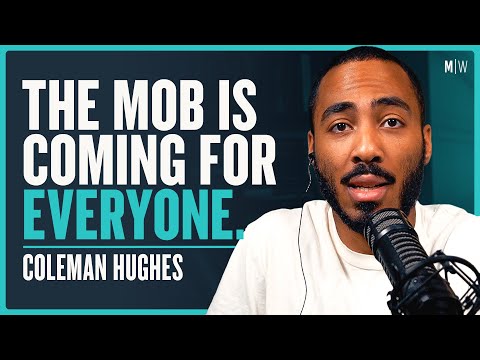
Joe Rogan's Censorship Battle - Coleman Hughes
WatchChris Williamson // 1:21:24
