The Architecture of Resilience: Lessons on Ambition, Burnout, and the Emotional Price of Growth
The Internal Price of High Achievement
Reaching the summit of any field often reveals a paradoxical truth: the very drive that propels you to success can become the primary source of your isolation. When we talk about the hard-charging go-getter, or the culturally memed alpha male, we are really discussing individuals with immense agency and upward mobility. However, this level of motivation is rare. Most people will not work as hard as you, and as a result, they cannot understand the specific pressures you face. You end up solo-rangering your journey, not necessarily because you want to, but because the path to elite performance is sparsely populated.
From a psychological perspective, this isolation is often self-imposed. Many individuals work at a breakneck pace to prove their worth to a world they feel doesn't value them inherently. If you believe the world only loves you for what it can extract from you, you will perform. You will create a loud, successful persona that eventually drowns out your true self. The louder the performance gets, the quieter the real person becomes. Breaking this cycle requires recognizing that your value isn't a variable of your output. We must bridge the gap between our achievements and our internal sense of safety.
Growth Germinates in the Low Points
We often view periods of sadness or disappointment as interruptions to our lives. In reality, these are the most fertile grounds for evolution. When life is going well, we rarely ask deep questions. We float down the stream, moving at the same speed as our environment. It is only when we hit the rocks—when we face burnout, health crises, or professional setbacks—that we are forced to reflect. Reflection is born from pain because we are desperately trying to find a way out of it.
Every major period of growth in your life has likely germinated from your lowest points. These moments act as a springboard. When you are forced to contend with your limitations, you develop a new type of resilience that success cannot teach. The objective is not to avoid the low energy or the "sad boy energy" that inevitably comes with being human, but to show up as a professional through it. You must learn to rely on your community during these times. If you always appear like the most competent person in the room, your friends won't know how to step in and help. Asking for help is not a sign of insufficiency; it is a strategic move to ensure you don't stay at the bottom longer than necessary.
The Behavioral Genetics of Obsession
Your psychological makeup is often a direct manifestation of your neurobiology. For example, the COMT gene (specifically the Met/Met variant) dictates how slowly you clear catecholamines like adrenaline and dopamine. If you possess this variant, you likely struggle with uncertainty and high-stress situations because your system takes longer to return to baseline. However, the flip side of this hindrance is a superpower: the ability to obsess, ruminate, and work with a depth of thought that others cannot match.
Understanding your genetic hardware allows you to stop fighting your nature and start tuning it. You aren't fragile; you are finely tuned. A Formula 1 car is less reliable than a Toyota Camry, but it performs at a level the Camry can't imagine. If you are someone who clears stress slowly, you must aggressively curate your environment. This means avoiding high-drama relationships and unpredictable friends while leaning into structured, predictable work environments. You pay a price for your depth, but the ROI on that depth is what allows you to achieve outlier success.
The Fallacy of the Perfect Journey
There is a Sigmund Freud quote that haunts every overachiever: "One day, in retrospect, the struggle will strike you as most beautiful." This suggests we are doomed to only appreciate our lives through the rearview mirror. The reason we struggle to enjoy the present is that it is cluttered with fear, uncertainty, and the persistent thought that we should be doing more. When we look at the past, the fears didn't come true, so we only see the beauty. When we look at the future, we see potential. The present is the only time that feels messy.
To find beauty in the struggle here and now, you have to acknowledge the absurdity of the journey. You must spend less time on your phone and more time sharing the experience with others. Happiness cannot exist where there is chronic uncertainty or a desperate desire for things to be different. If you are constantly whipping yourself for not being "better" or "more resilient," you are essentially being ungrateful for your own progress. The goal is to reach a state of equanimity where you can strive for the summit without hating the climb. Your future self will look back on this exact moment with fondness; your only job is to be present enough to validate that memory.
Navigating the Trap of External Perfectionism
High standards are a virtue, but they can easily metastasize into externalized perfectionism. This happens when you become rigid and unforgiving with others who don't share your drive. When people around you suggest you "don't have to work this hard," it can feel like they are chipping away at your motivation. This is often because your growth makes them feel "not enough," so they try to pull you back to a level that feels safe for them.
Honoring your drive while respecting others requires firm boundaries. You cannot change people by pointing fingers; they will only dig their heels in. Instead, call out the behavior. Tell your circle that even if you complain about the work, what you need is for them to infuse you with belief, not remind you that you can lower your standards. You must accept that your way is not the way for everyone. Some people are content with simple pleasures, and that is their right. Your task is to maintain your altitude without becoming bitter about the gravity that affects others.
Wisdom for the Lost and the Searching
If you feel lost in life, particularly in your late teens or early twenties, realize that this is the intended design of that life stage. You find the most interesting things when you are lost. The anxiety of not having a clear direction is actually the fuel for self-discovery. However, because your intuition hasn't yet been built by decades of experience, you shouldn't rely on "gut feelings" alone. Instead, set rules. Be procedural. Commit to a habit or a relationship for a set period and use that structure as a substitute for the intuition you haven't earned yet.
The magic you are looking for is almost always in the work you are avoiding. Whether it's facing an emotional challenge or sticking to a grueling training protocol, the avoidance is the indicator of where the growth lies. Differentiating between "draining" work and "harmful" work is simple: being drained is fine—you have plenty in the tank for the next decade. Being harmed means the work is plaguing your sleep and turning into a chronic, angry obsession. Lean into the former, set boundaries against the latter, and keep moving forward. Growth happens one intentional step at a time.
- Andrew Tate
- 10%· people
- Apple Notes
- 10%· products
- Arthur Brooks
- 10%· people
- Chris Williamson
- 10%· people
- COMT gene
- 10%· products
- Other topics
- 50%
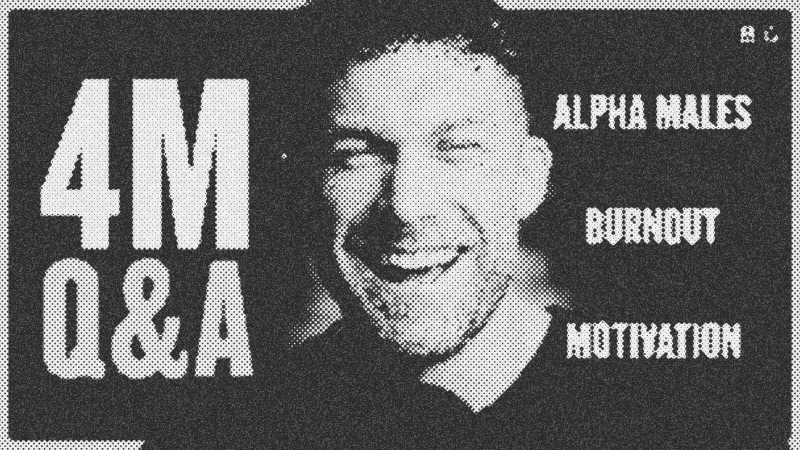
4M Q&A - Alpha Males, Burnout & Motivation
WatchChris Williamson // 1:25:47
