The Stress Tax: Why We Don't Have to Pay for Success with Our Souls
The Architecture of Modern Suffering
We live in a world that has been meticulously designed to be stressful. It is a system built on a deceptive premise: that anxiety and pressure are the unavoidable taxes we must pay for a successful life. This cultural narrative tells us that if we aren't stressed, we aren't working hard enough, and if we aren't working hard enough, we don't deserve the rewards of the modern era. However, this is a profound misunderstanding of both human biology and the physics of the soul. Mo Gawdat argues that stress is not a direct result of the events in our lives, but rather a calculation of those events divided by our perceived abilities and resources.
Think of it as a cross-section of an object in a physics lab. An object doesn't break simply because force is applied; it breaks because the force exceeds the capacity of its structure to distribute that weight. In human terms, our 'square area'—our resilience, skills, and emotional intelligence—determines whether a challenge becomes a growth opportunity or a source of chronic decay. We have been conditioned to believe that we must be 'cogs in a machine' to achieve, but real creativity and flow only happen when the machine is calm. The truth is that we are far more productive when we are contented and focused than when we are operating in a state of high-alert survival.
The 90-Second Rule and the Myth of Perpetual Crisis
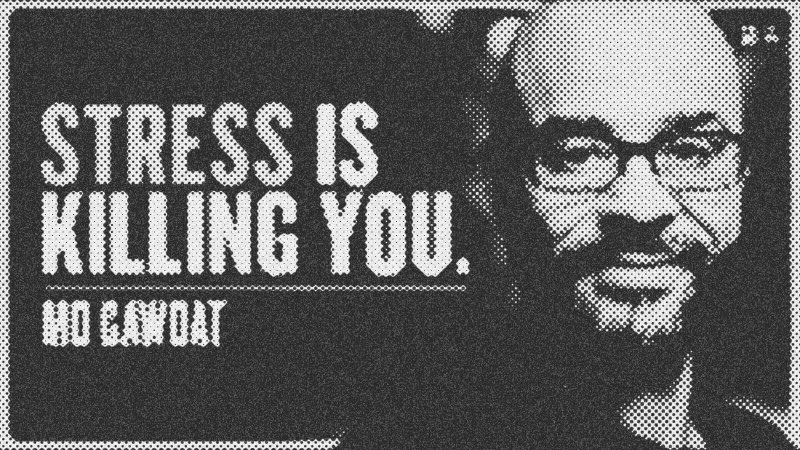
One of the most liberating biological facts is that the chemical surge of cortisol—the primary stress hormone—is completely flushed out of the human system within 90 seconds. If you feel stressed for longer than a minute and a half, it is because you are manually re-triggering that response. You are essentially pressing the 'alarm' button over and over again through your thoughts. The biological machine was designed to deal with immediate physical threats, like a predator in the wild. Once the tiger is gone or the fight is over, the system is supposed to return to a parasympathetic state of 'rest and digest.'
In the concrete jungle, however, the 'tiger' is a snarky email, a late train, or a thought about a future meeting. Because these aren't physical threats that we can run away from or fight, we keep the stress loop open. We deny ourselves the vital functions of recovery: replenishing muscles, digesting nutrients, and deep sleep. By staying in a constant state of fight-or-flight, we aren't taking advantage of the superhuman burst that stress provides; we are simply drowning in its toxic leftovers. Recognizing that you have a choice at the 90-second mark to look at a situation with your rational brain rather than your lizard brain is the first step toward reclaiming your peace.
The Mind Gym: Strengthening the Mental Muscle
Just as we go to the physical gym to build muscle, we must engage in what Mo Gawdat calls the 'Mind Gym' to build mental fitness. This isn't about ignoring problems; it's about training the brain to see the full picture of reality. The brain has a natural survival bias that forces it to look for what is missing or what is wrong. While this kept our ancestors alive, it makes the modern person miserable. To counteract this, we must practice intentional gratitude—not as a 'fluffy' exercise, but as a rigorous statistical correction of our perception.
Most of life is actually okay. If you have the mental bandwidth to worry about next week, it means you are safe right now. A high-level gratitude practice involves challenging the brain: every time it offers a negative thought, demand that it produce several positive ones. This builds neural pathways that automatically seek out the 'good' in every situation. Another vital exercise in the Mind Gym is 'yielding.' Yielding is the ability to distinguish between a challenge that requires 'grit' and a situation where life is clearly closing doors to redirect you. Sometimes the most successful action is not to push harder against a locked exit, but to turn the steering wheel toward the door that is actually open.
The Four Pillars of Stress: Mental, Emotional, Physical, and Spiritual
To truly address burnout, we must understand that humans are composed of four distinct modalities, each with its own language and requirements.
The Emotional Layer and the Gift of Anger
Emotional stress often stems from the suppression of our feelings. The Industrial Revolution taught us to view emotions as 'unproductive' or 'fluffy,' leading many to become 'comfortably numb.' But emotions are sophisticated data points. Anger, for instance, is a neutral energy that can be used to destroy or to fuel a speech that changes the world. Loneliness is a signal that our biological need for a tribe is not being met. By listening to the 'physical signatures' of emotions—like the knot in your stomach when you're anxious—you can begin to process them rather than letting them eat you from the inside.
The Physical Body and Inflammation
Physical stress is often the most direct but the most ignored. Your body speaks in aches, pains, and digestive issues. Mo Gawdat describes how shifting to an anti-inflammatory diet and respecting the 'ritual of sleep' can reverse years of chronic discomfort. Many high-achievers treat their bodies like a vehicle they can run into the ground, but even the best engine needs oil and downtime. If you are in pain, something is wrong; it is not a 'badge of honor' to suffer through it.
Spiritual Stress: The Void of Purpose
Perhaps the most insidious form of suffering is spiritual stress, which occurs when we live a purposeless life. This isn't necessarily about religion; it's about the alignment of your intuition with your actions. When your internal 'Arbitrage test' fails—meaning your logic, your heart, and your actions are all pointing in different directions—you experience a profound sense of unease. Spiritual stress is the world 'nudging' you back toward your true path. Ignoring these nudges often leads to life 'shoving' you through major crises to get your attention.
Reclaiming Your Heartbeats
Every human is born with a finite number of heartbeats. Most people spend their heartbeats collecting 'coins' (money, status, possessions) so they can eventually enjoy their future heartbeats. The tragedy is that for many, that future moment never arrives. The goalposts keep moving, and they die with a mountain of coins and a heart that never knew peace.
Becoming 'unstressed' requires a conscious choice to prioritize calm over ego and shame. It involves 'limiting' unnecessary stressors, 'learning' from the challenges that remain, and 'listening' to the signals from your four modalities. You don't have to overhaul your entire life in a single day. You simply have to commit to making tomorrow a tiny bit better than today. Whether that means cutting out an annoying social obligation, walking a little slower during your commute, or finally listening to that nagging intuition to start a project, growth happens one intentional step at a time.
- Mo Gawdat
- 11%· people
- Alice Law
- 6%· people
- Arun Gandhi
- 6%· people
- Brené Brown
- 6%· people
- Chris Williamson
- 6%· people
- Other topics
- 67%
The Science Of Happiness: New Insights - Mo Gawdat
WatchChris Williamson // 1:28:00
