The Architecture of Modern Belief: Navigating Post-Truth Media and Personal Evolution
The Abacus and the Magic Box: Why We Lost Our Epistemic Grounding
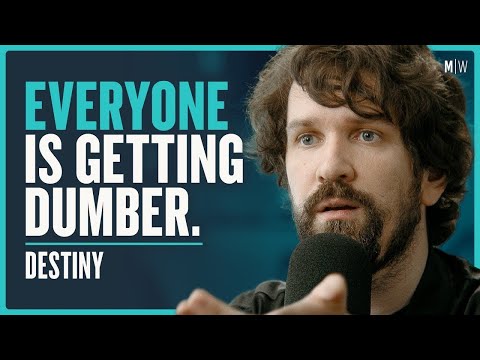
Our collective ability to distinguish fact from fiction is deteriorating, not because we are becoming less intelligent, but because the world has become too complex to verify. Destiny proposes a compelling analogy: the transition from the Abacus to the "Magic Box." In the era of the Abacus, the mechanics of a calculation were visible and undeniable. You could see the beads move. Today, we interact with highly complex systems—from smartphones to the FDA—where the "under the hood" operations are invisible to the average person.
This lack of transparency creates a vacuum. When people cannot see the internal workings of a system, they fill the void with narratives that satisfy their existing biases. This is how we end up in a world where normal plane crashes or disease outbreaks can no longer exist as simple, tragic events. Instead, they are immediately integrated into grand designs involving secret weapons or global conspiracies. We have traded empirical grounding for a hyper-flexible reality where everything is a sign of a larger, often malevolent, plot.
The Paradox of Digital Tribe Formation
We are currently witnessing a dual movement in social dynamics: we are becoming more different and more similar at the exact same time. On a global scale, major political and social groups are flying away from each other at the speed of light. However, within these groups, an intense, crushing homogeneity is enforced. Destiny argues that as our communities have grown from local neighborhoods to massive internet-facilitated tribes, the pressure to maintain a "pure" set of beliefs has skyrocketed.
In the past, you might have disagreed with a neighbor on one or two points but remained friends because of physical proximity. Today, the internet allows us to hyper-select for people who agree with us on every single metric. This eliminates the healthy friction that once forced humans to get along despite their differences. If you want to find a community that supports an obscure, irrational, or even harmful ambition, the internet will provide it instantly. This ability to select your reality rather than dealing with the one in front of you is a significant driver of modern societal fracture.
Constellations of Belief and the Jenga Tower of Identity
Beliefs are rarely generated from a consistent, underlying logical system. Instead, individuals inherit "constellations of beliefs" from their social groups. If you identify with a specific tribe, you don't just pick one stance; you adopt the entire package. If you believe Donald Trump is a victim of a "Deep State," you likely also believe that COVID-19 vaccines are dangerous, that the 2020 election was rigged, and that Russia is not a primary adversary.
These beliefs function like a Jenga tower with no foundation, held together by zero-gravity social pressure. Because they are all interconnected, you cannot pull one block out without the entire structure collapsing. If you admit the FDA might be trustworthy on one issue, it undermines the entire premise of the corrupt state that your social identity is built upon. This is why small disagreements on "applied positions" are often interpreted as total moral betrayals. Disagreeing with your tribe on a single policy point isn't seen as a nuance; it is seen as you "hating" the core group.
The Performance of Outrage vs. The Quantitative Bet
There is a depressing gap between what people claim to believe for social status and what they actually know to be true. Destiny describes his experiment of offering high-stakes bets to content creators who make certain claims. When someone asserts they are "99% sure" of a political outcome, but then refuses to take a bet at favorable odds, their internal logic immediately shifts. They start listing all the reasons why they might be wrong—factors they completely ignored while performing for their audience.
This reveals that people are often much smarter than they appear; they simply choose not to apply their critical thinking faculties because of social pressure. We have moved into an age where ridiculing the "out-group" provides more social currency than searching for truth. This performance of outrage activates the defense systems of the opposition, making it impossible to actually change minds. Truth becomes a secondary casualty to the desire to look "cool" and "dunk" on opponents.
Beyond the Soundbite: The Necessity of Long-Form Nuance
The current media landscape is addicted to the 30-second clip, a format that is inherently hostile to complex truth. Destiny highlights how his appearances on mainstream outlets like Piers Morgan Uncensored feel like a series of rapid-fire splurges rather than a discussion. These snippets are then further distilled by the internet into "rage-sharing" content.
If you say you like pizza, the internet interprets that as you hating Indian food. This binary, reductive way of processing information prevents any holistic understanding of a person's worldview. To combat this, we must look for four indicators of a trustworthy source: Do they ever surprise you? Do they ever admit they were wrong? Is their group bound by love of their own or hatred of others? And do they talk to the opposition for reasons other than mockery? Without these checks, we are simply consuming digital confirmation of our own biases.
The Chemical Self: ADHD and the Subjectivity of Mind
Personal growth requires a radical openness to the idea that our own minds may be misfiring. Destiny shares his journey from being a skeptic of ADHD to receiving an adult diagnosis and starting medication like Vyvanse. For years, he viewed his inability to focus on a single task as a moral failing or simple laziness. He believed that because he could play video games for 16 hours, he couldn't possibly have an attention disorder.
This shift in chemical perspective—realizing that his "subjective experience" of the world was fundamentally different from others—is a profound lesson in humility. It forces us to ask: Is this the "ordinary mind," or is my experience being skewed by biology? By acknowledging his ADHD, Destiny was able to move from a state of constant distraction and "masking" to a state of high-level retention and research. This highlights the importance of being open to scientific intervention and self-discovery, even when it challenges our long-held narratives about our own character.
Authenticity and the Future of Influence
As we look toward the future of media and the 2024 election, the currency of the realm is shifting toward authenticity—but not always in a positive way. People are desperate for "genuine" figures, yet Destiny warns that being genuine is not the same as being virtuous. A person can be a "genuinely bad person." The success of figures like Donald Trump often stems from a combination of humor and a perceived lack of curation, which charms audiences even when the facts are indefensible.
We must move past the idea that just because someone is "talking and not shouting," it is a good conversation. We need to evaluate the substance, not just the delivery. The future belongs to those who can navigate the "messy time" we are in by maintaining a moderated reaction to events, resisting the urge to jump from 0 to 100 on every cultural moment. Growth happens when we recognize our inherent strength to navigate these complexities, one intentional, well-researched step at a time.
- Destiny
- 21%· people
- ADHD
- 6%· medical conditions
- Donald Trump
- 6%· people
- FDA
- 6%· organizations
- Alex Jones
- 3%· people
- Other topics
- 59%
Have We Reached Peak Stupidity? - Destiny (4K)
WatchChris Williamson // 2:08:14
