The WEIRD Lens: How Cultural Evolution Shapes Biology, Psychology, and the Modern Mind
Beyond Human Nature: The WEIRD Origins of Modern Psychology
Most of us live under the illusion that our thoughts, preferences, and moral judgments are simply the product of a universal human nature. We assume that if you strip away the surface-level customs of any society, you will find the same psychological core. However, research into The Weirdest People in the World suggests something far more provocative. Most of what we categorize as "human nature" is actually cultural conditioning masquerading as biological hardwiring. This bias stems from a systemic flaw in psychological research: roughly 96% of subjects come from societies that are Western, Educated, Industrialized, Rich, and Democratic (WEIRD).
Joe Henrich, Professor of Human Evolutionary Biology at Harvard University, argues that these WEIRD populations are not the standard; they are the outliers. When we study people from small-scale societies or different historical lineages, the very structure of their personality, their sense of fairness, and their cognitive processing change. The transition from small-scale primate societies to modern industrial giants has fundamentally altered our phenotype. We are no longer just biological organisms; we are products of a thousand-year-old cultural program that has rewritten our brain chemistry.
The Ecology of Thought: From Rice Paddies to Individualism
Culture does not exist in a vacuum; it responds to the local ecology. One of the most striking examples of this is the psychological divide between rice-growing and wheat-growing regions, particularly within China. Growing paddy rice requires intensive, sustained, and cooperative labor. You cannot grow rice alone. This ecological necessity favors the development of strong, intensive clans and kin-based institutions. Consequently, these regions produce individuals who think more holistically and exhibit higher levels of nepotism.
In contrast, wheat-growing regions allow for more independent farming, which facilitates a more individualistic and analytical mindset. This shows that our social psychology is an adaptation to our environment through the institutions that environment favors. In Europe, a different set of institutional shifts occurred. The Roman Catholic Church began implementing marriage taboos that dismantled clans and forced people into small, monogamous nuclear families. This shift was not just a social change; it was the birth of the individual. Without the safety net of a massive clan, people had to form voluntary associations with strangers—leading to the creation of charter towns, universities, and eventually, the democratic systems we recognize today.
Monogamy as a Civilizing Force and the Problem of the Underclass
We often view monogamy through a moral or religious lens, but its primary function in cultural evolution is the domestication of the male. In societies that allow polygyny—where elite men take multiple wives—a dangerous math problem arises. If the top 10% of men have four wives each, a massive pool of low-status, unmarried men is created at the bottom of the hierarchy. Evolutionarily, these men are "zeros." With no stake in the future, they are willing to take extreme risks, leading to higher rates of violence, crime, and social instability.
Normative monogamy levels the playing field. It forces high-status men to compete for a single partner, leaving enough women for the rest of the population. This has a direct biological impact: getting married and having children reduces a man’s testosterone. This hormonal shift makes men less disagreeable and less likely to engage in risky, status-seeking behavior. They stop trying to impress the crowd and start protecting the nest. However, as marriage rates decline and the sexual marketplace becomes increasingly asymmetric due to digital dating and economic shifts, we risk returning to a society with a "sexless underclass," which historically has been a precursor to conflict and decline.
The Psychology of Innovation: Tight Norms vs. Creative Chaos
What makes a society innovative? It isn't just a collection of high-IQ individuals; it is the presence of "norm looseness." In societies with tight norms, people feel constantly watched and judged. They are less likely to deviate from established rules for fear of social sanction. While this creates high social cohesion, it is the enemy of creativity. Innovation requires the freedom to be weird, to fail, and to challenge the status quo.
Data from US patent records between 1800 and 1940 shows that "clumpy" societies—those with high kinship intensity—produce fewer innovations. Places like Australia and the United States thrive on low conformity and high overconfidence. While most overconfident innovators fail, a society with a high volume of risk-takers will inevitably produce a few "lucky" breakthroughs that propel the entire culture forward. This is further bolstered by non-zero-sum thinking. In a zero-sum world, your success is my loss. In the WEIRD world, we’ve cultivated the belief that the pie can grow, allowing us to celebrate the success of others rather than sabotaging them through jealousy or "tall poppy syndrome."
Shame, Guilt, and the Internalized Auditor
One of the most profound psychological shifts in human history is the move from shame-based to guilt-based societies. In a shame-based culture, the governing emotion is external. You feel shame when you violate a communal standard and others see you. It makes you want to disappear from view. Guilt, however, is an internal auditor. It is the emotion you feel when you fail to meet a self-imposed standard, even if no one else ever finds out.
Protestantism accelerated this internalization of standards. By insisting that every individual should read the Bible and have a personal relationship with God, it created a culture of self-monitoring. This "internalized auditor" is a massive economic driver. It makes people more trustworthy in transactions with strangers because they are being watched by an omniscient God or their own conscience. This is why belief in Hell is a stronger predictor of economic growth than belief in Heaven. Fear of spiritual or internal sanction creates a more industrious and less criminal population, laying the groundwork for complex, large-scale cooperation.
The Loneliness of Sovereignty: Can We Go Back?
As we have moved toward increasingly individualistic societies, we have gained unprecedented freedom and economic prosperity, but we have lost the "warm hug" of the clan. Modern social safety nets have externalized the responsibilities once held by family. We no longer need to be trustworthy or kind to our neighbors for survival; Uber has our credit card, and the government provides unemployment insurance. This has led to a profound sense of dislocation and loneliness.
We are currently at a crossroads. While we cherish our sovereignty and agency, our biology still craves the interdependence of a group. The challenge for the future is not to dismantle the progress of the last millennium, but to find ways to build enduring communities that offer the emotional warmth of the clan without the stifling conformity. We must recognize that while we are individuals, our greatest strengths are still rooted in the collective cultural institutions that shaped us. Growth happens one intentional step at a time, but those steps are easier to take when we aren't walking alone.
- Australia
- 6%· places
- Bible
- 6%· books
- China
- 6%· places
- Chris Williamson
- 6%· people
- Europe
- 6%· places
- Other topics
- 71%
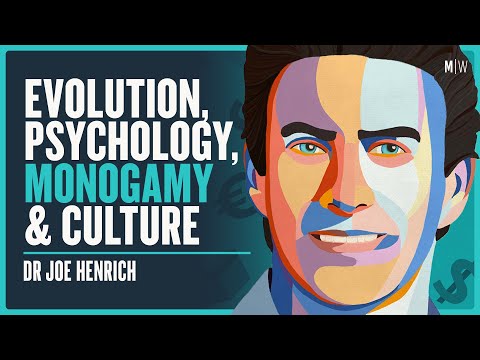
Evolution, Psychology, Monogamy & Culture - Dr Joe Henrich
WatchChris Williamson // 1:00:05
