The Fluke Effect: Embracing Chaos and Reclaiming Agency in an Unpredictable World
The Hidden Architecture of a Random World
We often treat our lives like a linear narrative where effort equals outcome and careful planning guarantees security. This psychological safety net allows us to wake up and function, but it ignores a startling scientific reality: the trajectory of human history and our individual lives is frequently dictated by the most microscopic, random events. From the specific targeting of atomic bombs in World War II to the exact timing of a morning commute, we are the beneficiaries and victims of a trillion tiny flukes. Understanding this isn't about surrendering to nihilism; it is about developing a more sophisticated form of resilience. When we acknowledge that the world is a complex, chaotic system, we can stop chasing the ghost of total control and start focusing on the profound influence we actually possess.
Historical turning points provide the most visceral evidence of this randomness. Consider the decision to drop the atomic bomb on Hiroshima instead of Kyoto. The Henry Stimson, Henry Stimson, intervened simply because he had spent a pleasant vacation in Kyoto nineteen years earlier. A personal memory of a charming city spared millions of cultural artifacts and redirected the path of destruction toward another population. Similarly, the second bomb hit Nagasaki only because a passing cloud obscured the primary target, Kokura. These aren't just footnotes; they are the fundamental building blocks of our reality. They prove that the macro-world we inhabit is built on a foundation of micro-contingencies.
The Psychology of Chaos and the Illusion of Control
Human beings are biologically hardwired to reject randomness. Our brains are evolved organ systems that reward pattern detection because, for our ancestors, missing a pattern meant death. If you hear a rustling in the grass, it is safer to assume a predator exists and run than to assume it is just the wind. This evolutionary trait, while essential for survival, has left us with a cognitive bias toward over-detecting order. We look at the chaos of the world and stitch together a story because the alternative—that we are floating in a sea of unpredictable variables—is too terrifying for the average psyche to bear.
This leads to what I call the illusion of control. In the modern West, we have engineered a world of extreme day-to-day stability. We can predict exactly when our Amazon package will arrive or what a Starbucks latte will taste like in a different country. This surface-level predictability masks a deeper, growing fragility. While our daily routines have never been more stable, the global systems we depend on—democracies, economies, and climates—have become increasingly complex and prone to sudden, massive shifts. We are living in a world where the Starbucks menu never changes, but the political systems that allow it to exist can collapse overnight due to a single viral mutation or a lone actor's decision.
The Sandpile Model of Systemic Fragility
To understand how small events trigger massive changes, we must look at the sandpile model. Imagine adding grains of sand one by one to a pile. For a long time, the pile grows steadily. But eventually, the pile becomes so tall and its structure so unstable that a single, identical grain of sand causes a total avalanche. The grain isn't "special," but the system's state has become fragile. We see this in social systems like the Arab Spring. When Muhammad Bouazizi set himself on fire in Tunisia, he was the final grain of sand on a pile that had been growing for decades. In a more resilient system, like Norway, such a tragic act would not spark a civil war. This teaches us that while we cannot predict the specific "spark" or fluke, we can observe and manage the height of our own metaphorical sandpiles.
Contingency vs. Convergence: The Two Forces of Fate
In the study of evolutionary biology and social history, two competing forces shape outcomes: contingency and convergence. Contingency is the idea that "stuff happens." It is the asteroid hitting the Yucatan Peninsula at exactly the right second to vaporize gypsum and create a toxic cloud that killed the dinosaurs. If that rock had arrived a second earlier or later, it might have hit deep ocean, the dinosaurs might have survived, and mammals—including humans—might never have risen to dominance. Our existence is entirely contingent on that one-second window sixty-six million years ago.
Convergence, on the other hand, represents the patterns and rules that the world tends to follow. For instance, the human eye and the octopus eye are remarkably similar in structure despite the two species diverging 600 million years ago, long before eyes even existed. Evolution solved the same problem twice using the same blueprint. This suggests that while flukes (contingency) can knock us off our path, there are certain "attractors" or outcomes that are more likely because they work efficiently within the laws of physics and social dynamics. Success in life requires navigating both: recognizing the fluky nature of our opportunities while adhering to the convergent principles of hard work and emotional intelligence that tend to produce results over time.
Reclaiming Agency: We Control Nothing but Influence Everything
If the world is truly this chaotic, how do we find the motivation to act? The answer lies in shifting our perspective from control to influence. Control is a binary—you either have it or you don't. Influence is a ripple effect. Every word you speak, every small kindness you show, and every minor decision you make alters the trajectory of the universe in ways you can never fully see. I call this the "unlimited influence" model.
You are not an interchangeable cog in a machine. You are a pivotal actor in a chaotic system where "noise" is actually signal. Consider the story of the 9/11 survivor who lived because he stopped to iron a shirt. He felt survivor's guilt, especially when people told him "everything happens for a reason." That phrase is actually damaging because it implies a cosmic necessity to tragedy. The truth is more profound: he survived because of a series of random choices and a gift from a colleague. His life now has meaning not because a higher power saved him, but because he has the agency to use the time he was randomly given to influence the world for the better.
The Power of Productive Experimentation
Since we cannot forecast the future with certainty, the most logical strategy is experimentation. If you believe the world is a fixed, predictable place, you will stay in your rut because you think you've already found the "optimal" path. But in a fluky world, the optimal path is often discovered by accident. By stepping out of your comfort zone, trying new hobbies, or talking to strangers, you increase the surface area for "positive flukes" to enter your life. You are essentially throwing more seeds into the wind, knowing that while you can't control which ones sprout, you've significantly increased your odds of a harvest.
Building Resilience in the Face of the Unknown
True resilience isn't about being bulletproof; it's about being adaptable. Modern life encourages us to over-optimize our schedules, our finances, and our relationships. We try to squeeze the last 3% of efficiency out of every day. However, in Chaos Theory, over-optimized systems are the most fragile. A supply chain with "just-in-time" delivery is highly efficient until a single ship gets stuck in the Suez Canal, causing a global economic crisis.
We must build "slack" into our lives. This means investing in things that are resilient to the whims of the market or the chaos of politics—things like deep relationships, personal character, and self-awareness. When your identity is tied to an optimized career path, a single fluke can destroy you. But when your identity is rooted in your inherent strength and your ability to navigate challenges, you become like the shorter sandpile: less prone to a total collapse when the next unexpected grain of sand falls.
A New Way to See Your Story
The realization that our lives are shaped by chance should be liberating, not terrifying. It humbles us when we succeed, reminding us that we aren't as brilliant as we think, and it comforts us when we fail, reminding us that we aren't as flawed as we fear. We are all participants in a grand, interconnected dance. Your life matters because it is a series of moments that will echo for a thousand years in the lives of people you will never meet. Stop trying to master the chaos and start learning to move with it. Growth happens when you stop fighting the randomness and start recognizing your power to influence the ripples you leave behind.
- Henry Stimson
- 6%· people
- Kyoto
- 6%· places
- 9/11
- 3%· events
- American Civil War
- 3%· events
- American Revolution
- 3%· events
- Other topics
- 79%
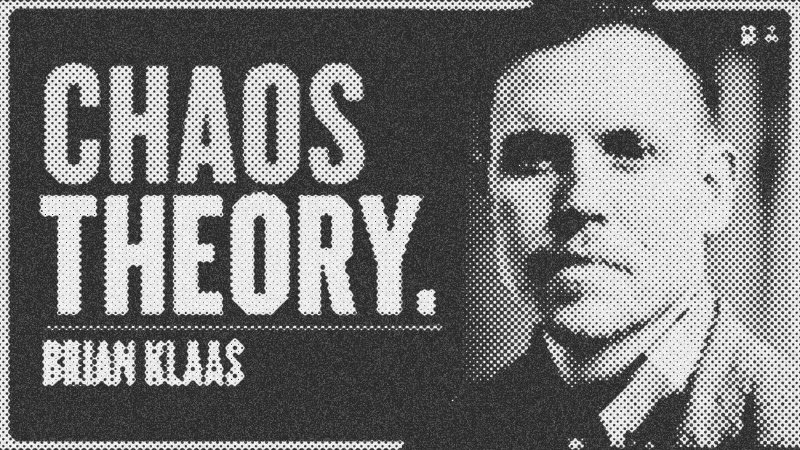
Why Small Events Matter More Than You Think - Brian Klaas
WatchChris Williamson // 1:29:50
