DeepMind research scientist Brendan O’Donoghue reveals text diffusion outpaces autoregressive models
The shift from sequential to iterative text generation
The prevailing architecture for Large Language Models has long been autoregressive, where the system predicts the next token based solely on the sequence that preceded it. This causal approach is linear and predictable, but it carries inherent limitations in reasoning and hardware efficiency. Brendan O'Donoghue, a research scientist at Google DeepMind, argues that the future of text generation lies in Text Diffusion. Unlike traditional models, diffusion processes treat text generation as a denoising task. The model starts with a canvas of random noise—purely random tokens from a vocabulary—and iteratively refines the entire block of text simultaneously.
This fundamental change in how we "write" code or prose means the model is no longer blind to the future. During the training phase, researchers corrupt ground truth sentences with noise and teach the neural network to fill in the missing information. At inference time, the model doesn't just add to the end of a string; it revisits every token in the sequence across multiple forward passes, allowing for a level of global coherence that sequential models struggle to maintain.
Solving the memory bottleneck through hardware efficiency
To understand why diffusion models feel faster to a single user, we have to look at the physical constraints of modern GPU and TPU hardware. Most generative models today are memory-bound, meaning they are bottlenecked by the speed at which data moves between High Bandwidth Memory (HBM) and the chip's tensor cores. In an autoregressive setup, generating 256 tokens requires 256 separate memory transfers of the entire model weight set and the KV cache. It is a slow, repetitive process that leaves the chip's massive compute power idling while waiting for data to arrive.
Text Diffusion flips this ratio. Because the model processes the entire block of tokens at once, it might only require 24 denoising steps to generate those same 256 tokens. This results in roughly ten times fewer memory transfers. For a single user, this translates to blistering speeds—reaching upwards of 2,000 tokens per second in the Gemini Diffusion research preview. However, there is a catch: while latency for one user is low, the overall throughput for massive batches is currently lower than autoregressive models, making it more expensive to serve at a global scale like ChatGPT.
Bidirectional reasoning and the power of self-correction
One of the most striking advantages of Text Diffusion is its ability to perform bidirectional reasoning. Since the model can see the entire "future" of the response it is currently refining, it can identify logical errors mid-generation and fix them. O’Donoghue demonstrates this with a complex math problem that tripped up frontier models like GPT-4o and Gemini 1.5 Flash. While GPT-4o confidently stated an incorrect initial answer and only corrected itself after finishing its reasoning, the Gemini Diffusion model actually went back and changed its initial answer on the canvas once its internal logic matured during later denoising steps.
This capacity for in-place editing is revolutionary for software development. It allows the model to perform "adaptive computation," spending more denoising steps on hard logical problems while breezing through easy tasks like memorized digits of pi. It also enables surgical code edits; rather than rewriting an entire file to fix a single bug, a diffusion model can target the specific lines, using the surrounding context as a stable anchor.
Real-time interfaces and the end of the loading bar
The practical implications of 2,000 tokens per second go beyond simple chat. When latency drops this low, the barrier between "generation" and "interaction" disappears. DeepMind's demos show entire Wikipedia pages, including the HTML structure and text, being generated on the fly. Users can click through an AI-generated operating system where every menu, file, and screen is dreamed up in real-time. Perhaps most impressively, developers can use voice commands to build functional applications, like a to-do list with dark mode and sorting features, in under 15 seconds. This isn't just about making current tools faster; it's about unlocking a new class of on-device applications for robotics and mobile devices where immediate, low-latency reasoning is a hard requirement.
Conclusion
Text Diffusion represents a departure from the token-by-token treadmill that has defined the last half-decade of AI. While the industry is currently obsessed with throughput and cost-to-serve, the qualitative benefits of bidirectional reasoning and adaptive compute are becoming too large to ignore. As Google DeepMind prepares for its next generation of releases, the focus shifts from whether these models can compete on quality to how developers will utilize the sudden surplus of speed. The era of watching a cursor blink as a model thinks may be coming to an end.
- Text Diffusion
- 20%· technology
- Gemini Diffusion
- 10%· products
- Google DeepMind
- 10%· companies
- GPT-4o
- 10%· products
- Alphabet
- 5%· companies
- Other topics
- 45%
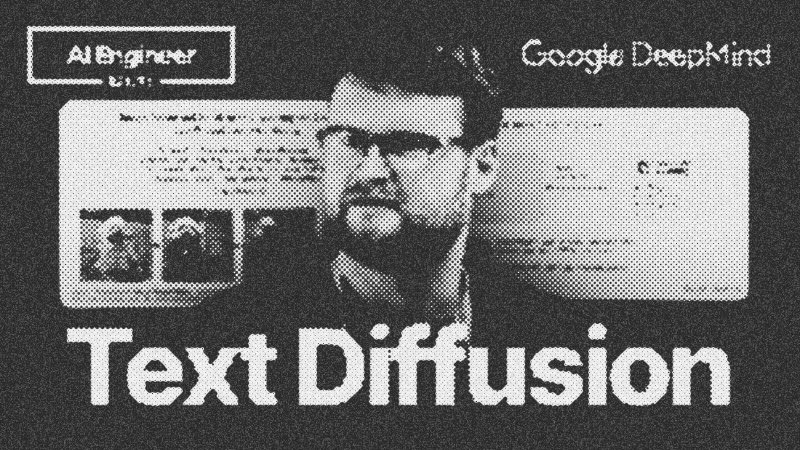
Text Diffusion — Brendan O’Donoghue, Google DeepMind
WatchAI Engineer // 28:03

We turn high signal in-person events for the top AI engineers, founders, leaders, and researchers in the world into the best free learning opportunities for millions around the world here on YouTube. Your subscribes, likes, comments, speaking, attendance, or sponsorships goes a long way toward making our biz model sustainable indefinitely. We strongly believe this industry deserves a better class of community and that we know how to do this well; we just need your support.