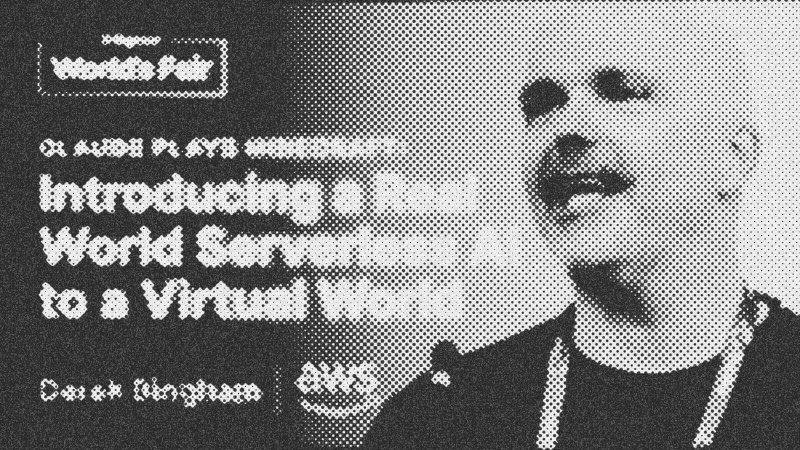
Derek Bingham drops Claude 3 Haiku into Minecraft to build autonomous agents
Constructing an Agentic Workflow in a Blocky World
Building an agent that doesn't just chat but actually acts requires a shift from simple request-response cycles to an agentic workflow. In this environment, the Minecraft world serves as the perfect sandbox for testing autonomous behavior. The workflow functions by consuming unstructured chat data, passing it through a Large Language Model (LLM), and then orchestrating tool use to satisfy a request. Unlike standard chatbots, this agent, named Rocky, interprets environmental state and returns tangible results within the game engine.
Core Technologies and Prerequisites
To build a similar system, you should be comfortable with JavaScript or Node.js and basic cloud architecture concepts. The project relies on several specialized tools:
- Amazon Bedrock: A managed service that provides a common API to access various high-performing models.
- Claude 3 Haiku: Selected for its speed and efficiency, making it ideal for real-time game interactions.
- Mineflayer: A powerful, open-source JavaScript API for Minecraft that allows for bot automation.
- Amazon ECS: Used to host the persistent state of the Mineflayer client, as serverless functions like AWS Lambda cannot maintain the long-lived connection required by the game protocol.
Architecting the Serverless Backend
The architecture evolved from a complex LangChain implementation on AWS Lambda to a more streamlined approach using Amazon Bedrock agents. The game client and Mineflayer run within a container on Amazon ECS. When a user types a command in chat, the client calls the Amazon Bedrock agent. The agent uses "Return of Control," allowing it to signal back to the client which tool to execute without the LLM needing to manage the low-level execution logic directly.
From Natural Language to JSON Schemas
The most critical component of the build is the prompt engineering that translates vague human requests into structured data. For complex tasks like building structures, the system uses a specific prompt that instructs the model to act as an expert builder and output valid JSON. This JSON contains the precise X, Y, and Z coordinates for every block.
{
  "structure": "double_decker_couch",
  "blocks": [
    {"x": 0, "y": 0, "z": 0, "type": "wool"},
    {"x": 0, "y": 1, "z": 0, "type": "wool"}
  ]
}
By strictly adhering to these rules, the agent avoids generating "nonsense" and ensures all blocks are placed adjacent to one another, allowing for the successful construction of intricate objects like a double-decker couch.
Practical Lessons and Gotchas
When deploying agents in a 3D space, state management is the biggest hurdle. You cannot easily run the bot logic on AWS Lambda because the Minecraft protocol expects a persistent socket. Furthermore, prompt instructions must be explicit about the available block palette, or the model may attempt to use items that do not exist in the current game version. Always utilize the "trace" feature in Amazon Bedrock to debug the agent's Chain of Thought when it fails to trigger the correct action.
- Amazon Bedrock
- 19%· products
- AWS Lambda
- 14%· products
- Minecraft
- 14%· products
- Mineflayer
- 14%· products
- Amazon ECS
- 10%· products
- Other topics
- 29%
Claude plays Minecraft!
WatchAI Engineer // 18:16

We turn high signal in-person events for the top AI engineers, founders, leaders, and researchers in the world into the best free learning opportunities for millions around the world here on YouTube. Your subscribes, likes, comments, speaking, attendance, or sponsorships goes a long way toward making our biz model sustainable indefinitely. We strongly believe this industry deserves a better class of community and that we know how to do this well; we just need your support.