The Disruption of the Soul: Navigating Status, Capitalism, and the Myth of Meritocracy
The Architecture of Status Anxiety
Modern existence operates on a high-speed treadmill of comparison. We are richer than any generation in human history, yet we are plagued by a restlessness that borders on the pathological. This isn't an accident; it is the logical conclusion of a world that has replaced settled village life with the hyper-anxiety of urban modernity. Alain De Botton identifies status not as a mere desire for fancy cars or corner offices, but as a desperate hunger for love. In our current framework, what you do defines who you are. This creates a precarious psychological environment where your right to exist in the eyes of others is contingent upon your latest professional win.
We have moved from cyclical time—where history was expected to repeat itself and social structures remained stable—to a linear, novel-driven obsession. The media reports on the new and the groundbreaking, fueling a belief that we are always in uncharted waters. This is exhausting. It strips away the comfort of patterns and replaces it with the weight of absolute individual responsibility. If you fail in a world that tells you the sky is the limit, the implication is that the failure is entirely your own.
The Fallacy of the Self-Made Winner
The shift in vocabulary from the ancient world to the modern era reveals a harsh psychological truth. In pre-modern societies, a poor person was often called an "unfortunate." This term acknowledged the role of Fortuna, the goddess of luck. Success was seen as a combination of skill and divine intervention. Today, we use the word "loser." This shift implies that we are operating in a perfectly fair race. If the race is fair, and you don't win, you don't just lack resources—you lack merit.
Alain De Botton challenges the very foundation of meritocracy that politicians and business leaders worship. While a meritocratic society is a beautiful ideal compared to hereditary aristocracy, its dark side is a brutal system of judgment. When we believe those at the top deserve to be there, we must also believe those at the bottom deserve their fate. This creates a culture of snobbery—a rigid, one-dimensional method of assessing human value based on bank balances or job titles. It ignores the macro luck elements of being born into the right family, in the right country, at the right time. We are not the sole authors of our lives, yet we live under the crushing weight of that assumption.
The Internal Sabotage of Success
In the startup world, we talk about "hustle" and "grit," but we rarely discuss the unconscious patterns that dictate our trajectory. Alain De Botton points to a startling reality: many people are driven toward failure by unresolved childhood dynamics. The idea that every parent wants their child to succeed is a convenient myth. In reality, families are often sites of intense envy. A parent who hasn't found fulfillment themselves may unconsciously view a child's meteoric rise as a threat to their own ego.
Messages are sent through micro-moments—the way butter is stored or the tone used when discussing a neighbor's promotion. These signals can tell a child that success is okay, but only up to a point. They might be allowed to make money but forbidden from being happy, or allowed to be brilliant but required to sabotage their personal relationships. Understanding these invisible scripts is critical for any entrepreneur. You might think you're fighting the market, but you might actually be fighting an internal prohibition against your own potency.
The Search for Meaning in a Scaled World
Meaningful work is defined by the reduction of suffering or the increase of pleasure for another human being. The problem with modern capitalism isn't a lack of meaningful tasks; it's a problem of scale and the division of labor. Adam Smith correctly identified that dividing tasks increases profitability, but we've realized it also divides meaning. When you are one gear in a 10,000-person machine, you lose the thread of the narrative. You are playing a seven-year football game on 140 different pitches where the goal is announced after you've retired.
This is why founders often fantasize about running a bakery or a bed-and-breakfast. It isn't that those jobs are easy—they are notoriously difficult with razor-thin margins. The appeal lies in the immediate feedback loop. You bake a loaf of bread, someone eats it and smiles, and you see the direct impact of your labor. Large-scale business requires "storytelling" not just as a marketing gimmick, but as an essential psychological tool to remind employees why they should get out of bed. Leaders must act as curators of the imagination, constantly re-linking the daily grind to the ultimate human impact.
The Corporate Family Knot
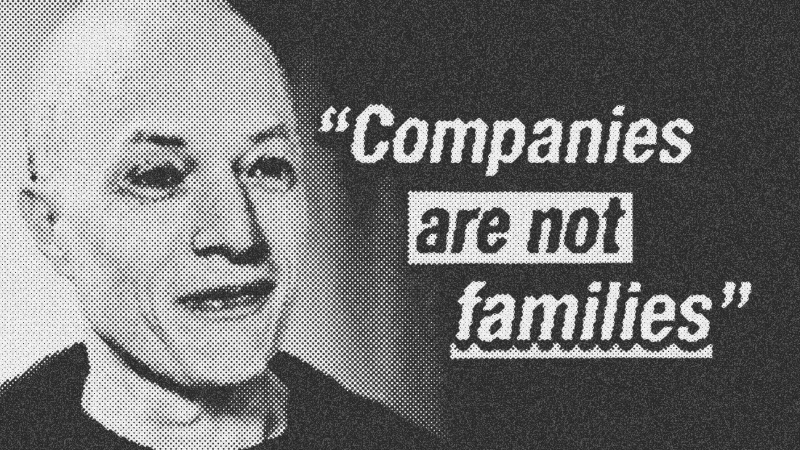
One of the most dangerous trends in modern business strategy is the adoption of familial language. When companies claim to be a "family," they are borrowing the language of private life to foster a short-term sense of togetherness. This is a trap. Families do not lay people off. An office is an association of people coming together to produce a service at a profit. When you blur these lines, you create deep incoherence.
Alain De Botton argues that we should not bring our "full selves" to work. Your full self includes the part of you that is two years old, the part that is irrational, and the part that is filled with infantile rage. Professionalism is a welcome superficiality. It allows us to function without the burden of everyone's complex, arduous truths. A leader should not seek to know every employee's soul but should focus on who that person aims to be. By honoring the professional identity, we provide a space where people can be their best selves, rather than their whole selves.
Capitalism as an Entrepreneurial Challenge
Capitalism is often criticized for its immorality, but its true flaw is its neutrality. It doesn't care if you buy psychotherapy or a handgun; it only cares about the energy of consumption. Advertising hijacks our unformed desires, convincing us that the low feeling we have on a Tuesday afternoon can be solved by a new car or a specific brand of rum. We want the friendship shown in the commercial, but we buy the bottle and drink it alone in the dark.
This creates a massive opportunity for the visionary entrepreneur. Instead of exploiting human weakness through gambling or low-value consumerism, the next wave of disruption should focus on genuine sources of unhappiness. If your partner speaks to you in an aggressive tone, that is a business problem. It is a pain point that needs a solution—whether through education, technology, or new service models. A capitalism worthy of esteem is one that aligns profit with the UD dionic project: the flourishing of the human animal. The market isn't saturated; it is simply focused on the wrong things. The next great fortunes will be made by those who can decode the subtle, psychological needs that traditional industry has ignored.
- Alain De Botton
- 25%· people
- 20VC
- 6%· organizations
- Adam Smith
- 6%· people
- Capitalism
- 6%· concepts
- Fortuna
- 6%· people
- Other topics
- 50%
Alain De Botton: Why Status is Making You Miserable & Why Parents Want Their Kids to Fail
Watch20VC with Harry Stebbings // 1:11:43

20VC, hosted by Harry Stebbings, takes you inside the world of Venture Capital, Startup Funding and The Pitch. Join Harry and discover how you can attain funding for your business by listening to what the most prominent investors are directly looking for in startups, providing easily actionable tips and tricks that can be put in place to increase your chances of getting funded. The Twenty Minute VC also provides an instructional guide as to what it takes to get employed in the Venture Capital industry, with VCs giving specific advice on how to get noticed from the crowd and increasing your chances of employment. Our amazing Venture Capitalists also provide their analysis of the current technology market, providing advice and suggestions on the latest investing trends and predictions. Join us so you can see how you can get big, powerful improvements, fast.